
Camberwick Green Revisited
Remembrance of puppetry past

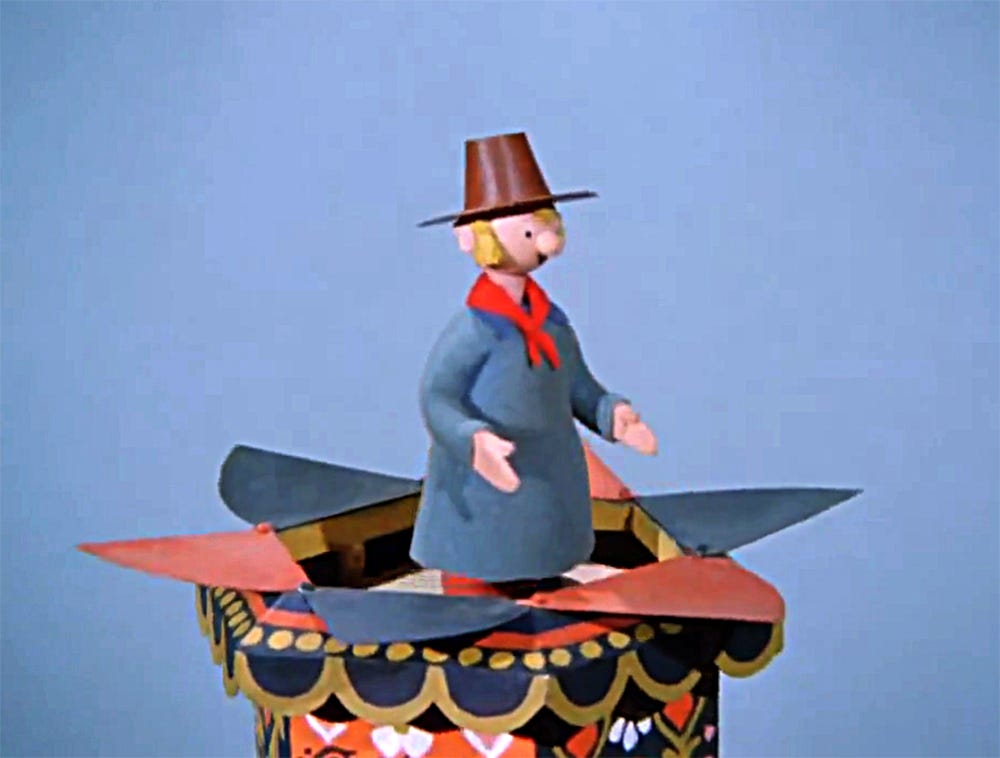
Here is a box, a musical box, wound up and ready to play. But this box can hide a secret inside! Can you guess what is in it today?
I’ve been revisiting, half a century on, the BBC TV Watch With Mother classic Camberwick Green on Prime Video. If you have the misfortune not to have grown up in the UK in the late 1960s and the 1970s, then you won’t understand how much unbridled joy the rhyme above heralded.
Fifteen minutes of puppetry paradise lay ahead - drinking in every slow-moving moment with wide, and (as-yet) unsullied eyes, trying to slow time down by sheer force of childish will. Even though not much happened, you had to pay very close attention - holding your breath - because VCRs, let alone YouTube, were not a thing yet.
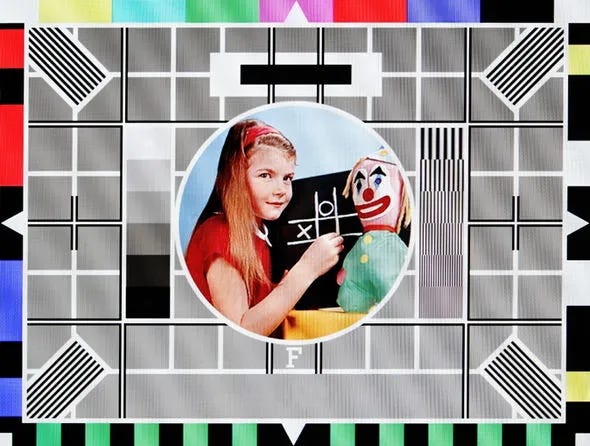
In truth, TV was barely a thing at that point - there were only three channels and they mostly screened testcards. BBC1 only broadcast 7-8 hours a day in 1966 when Camberwick Green first aired. (And just two years earlier there had only been two TV channels.)
The unmissable content? Some stop-motion animated puppets without mouths going about their delightfully dull lives in an imaginary village, set in a timeline which was mostly Edwardian England, but with some 1960s intrusions, such as milk floats and tractors. Accompanied by a cheery singalong song whenever a character was on his way to somewhere equally dull nearby. (In many ways Camberwick Green was rather like Upper Poppleton, the North Yorkshire village I grew up in.)
All narrated and voiced by the sainted Brian Cant, who also sang the cheery songs. Like a fantasy dad entertaining his kids.
I lived for Gordon Murray’s show as a sprog, barely able to contain my excitement over which character would emerge from the revolving, colourfully-painted music box to the sound of a haunting baroque minuet played on a glockenspiel.
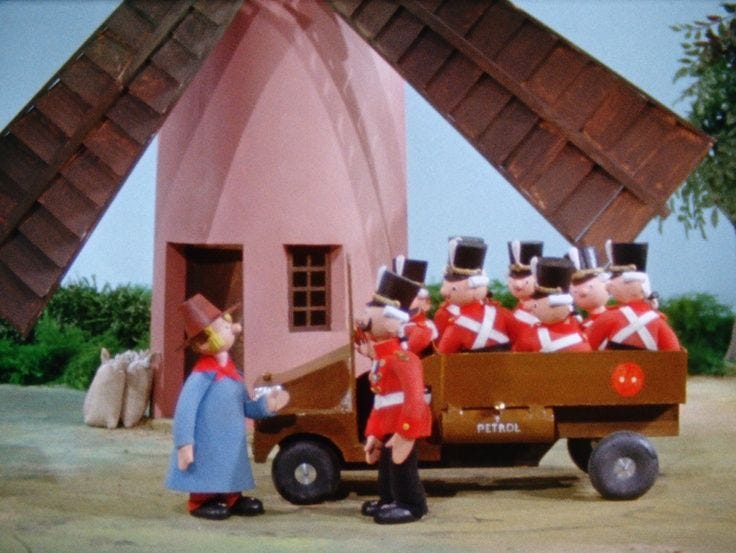
Would it be Windy Miller, Camberwick Green’s organic farmer and cider microbrewer? Captain Snort of Pippin Fort ( “He’ll work a boy as hard as he can/To turn him into a soldier man!“)? Mickey Murphy the “master baker”? Farmer Jonathan Bell and his “modern mechanical farm”? Or “the big friendly policeman/PC McGarry No. 452”?
I can report that Camberwick Green is still magically captivating as an ancient adult with all those 21st century distractions at my fingertips. And yes, this is mostly down to the terrible vice of nostalgia and the equally irresistible notion of lost innocence.
But not entirely. The past is familiar, but also a foreign country.
The simply-styled puppets (all missing a mouth), the astonishingly labour-intensive, 22,500 photos/frames-an-episode stop-motion (the analogue anti-thesis of a digital, AI world), the peculiarly mesmerising foot-pulling way they ‘walk’, the bucolic settings and scenery – and the singalong songs – along with Cant’s charming RP voice, are beguiling in their own right. They are fragments not just of a long lost childhood, before all the disappointments of life, but also of a vanished world where not very much happened by today’s accelerated standards, but it happened with your full, devoted and real-time attention.
And soon, we who grew up with this will vanish too. Like the characters at the end of the show who, revolving round and round again, slowly disappeared back into the dark bowels of the music box from whence they came.
But before that, I should mention that half a century on I notice, in addition to some details that HD reveals but 1970s Radio Rentals TV concealed, such as the dusty fingerprints on the lid of the music box, and the anatomically correct foam trousers, that almost all the characters are male.
And by far the most featured female is ‘Mrs Honeywell and the Baby’, a petticoated garrulous gossip always wheeling around a pram. All the chaps are constantly trying to politely but desperately edge away from her before she buttonholes them and asks them to hold the baby.
Camberwick Green was the Edwardian Village People. And I think you can understand now why I turned out the way I did. The BBC did this to me.
This homosocial - and sexist - sensibility was essentially repeated with the more proletarian (but definitely not urban) spin-off Trumpton (1967), Camberwick Green’s shire town, which featured the fire brigade in every episode, with the stentorian Captain Flack’s famous roll call etched on the impressionable brains of millions of UK kids:
“Pugh! Pugh! Barney McGrew! Cuthbert! Dibble! Grubb!”
(I shall refrain from making any puerile jokes here - but only because they’ve all been made already.)
Trumpton’s version of Mrs Honeywell and the Baby was even camper - Miss Lovelace, a single milliner who, instead of millinering, is always walking her three Pekingese dogs, Mitzi, Daphne, and Lulu, and seems to have been styled after Dame Edith Sitwell.
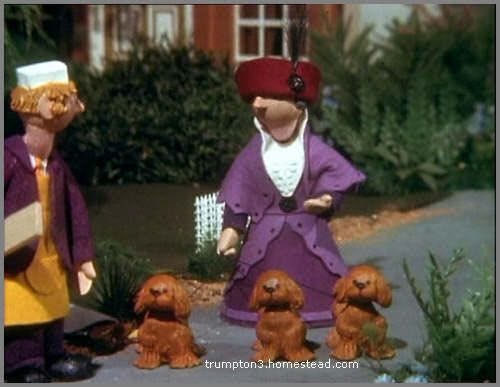
The final spin-off, Chigley (1969) is however, with the hindsight of gay dotage, the campest of all three shows. Set in another village near Camberwick Green, it stars moustachioed Lord Belborough who lives at Winstead Hall, a large neo-classical stately home, with his partner Mr Brackett, who pretends to be his butler. (Male homosexuality had only been partially decriminalised in the UK two years earlier - ‘…this box can hide a secret inside’).
No one else lives in that huge old Hall with them. Not even a housekeeper.
They both enjoy dressing up as engine drivers, have their own private railway and a steam engine called ‘Bessie’ (the only woman in their lives), with which they love to pretend to be useful and working class, picking up crates from canal boats at Chigley wharf. Stealing work from those that actually need it. (Though in Trumptonshire, where it is always summer, and every day is a ‘beautiful’ one, there is no sight nor mention of money - perhaps because if it existed, it would slip out of their fingerless hands.)
Whenever the telephone rings in Winstead Hall there is a steam-driven errand to run, and his Lordship, upon being informed of the latest request, always enthuses: “Splendid! Come on Brackett! Let’s get changed!“
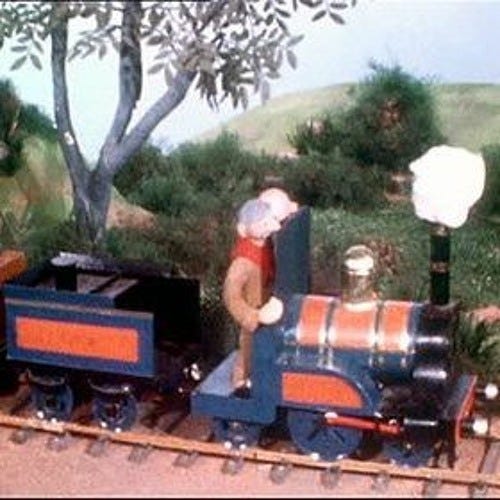
And change they do - into butch overalls, which give Lord B a very peculiar, elbows-out gait, like a matelot in a Force 8. Or a drag king on Netflix. They then mount Bessie and, exquisite balls of cotton wool smoke emerging from her funnel, papier Mache countryside sliding past to chuffing sounds, Mr Cant launches into their song ‘Time Flies By (When I’m the Driver of a Train')’ - which was and remains my favourite singalong of the Camberwick Green-Trumpton-Chigley triptake. (But which now, now that time has indeed flown, takes on a more melancholic aspect.)
Time flies by when I’m the driver of a train
And I ride on the footplate there and back again
Under bridges over bridges to our destination
Puffing through the countryside there’s so much to be seen.
Passengers waving as we steam through a station.
Stoke up fireman for the signal is at green.
After all that puffing, each episode ends with the 5 o’clock horn blowing at Chigley biscuit factory, where those not fortunate enough to own Chigley have been working all day. And where most of the kids watching this show were supposed to end up.
The dungareed workers, every single one of them male (and, like everyone else in Trumptonshire, white), stream out of the gates not to head to the pub, or play footie, or even go home, but to take part in the compulsory daily folk dancing, hosted and overseen by Lord Belborough and Brackett, changed back into their posh clothes - and playing a Dutch barrel organ.
I am not making any of this up. (See photographic evidence below.)
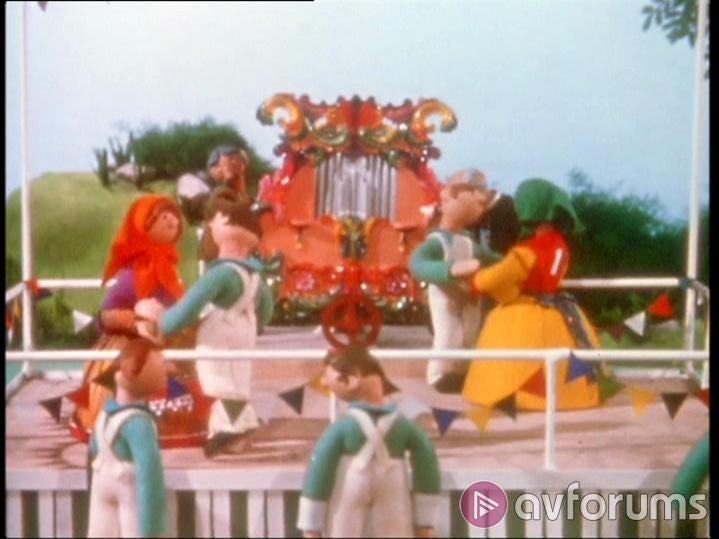
Then, as if by magic - and certainly with no explanation or introduction - two ladies suddenly appear for the male workers to dance with. Though perhaps they are just male workers in folk-dress drag.
Designed and styled by Lord Belborough and Bracket.
Giving the musical box’s ‘secret’ away, this complete Camberwick Green episode on YT stars Captain Snort, his soldier boys, their “rumpty-bumpty army truck” - and also features Mrs Honeywell and the Baby.